

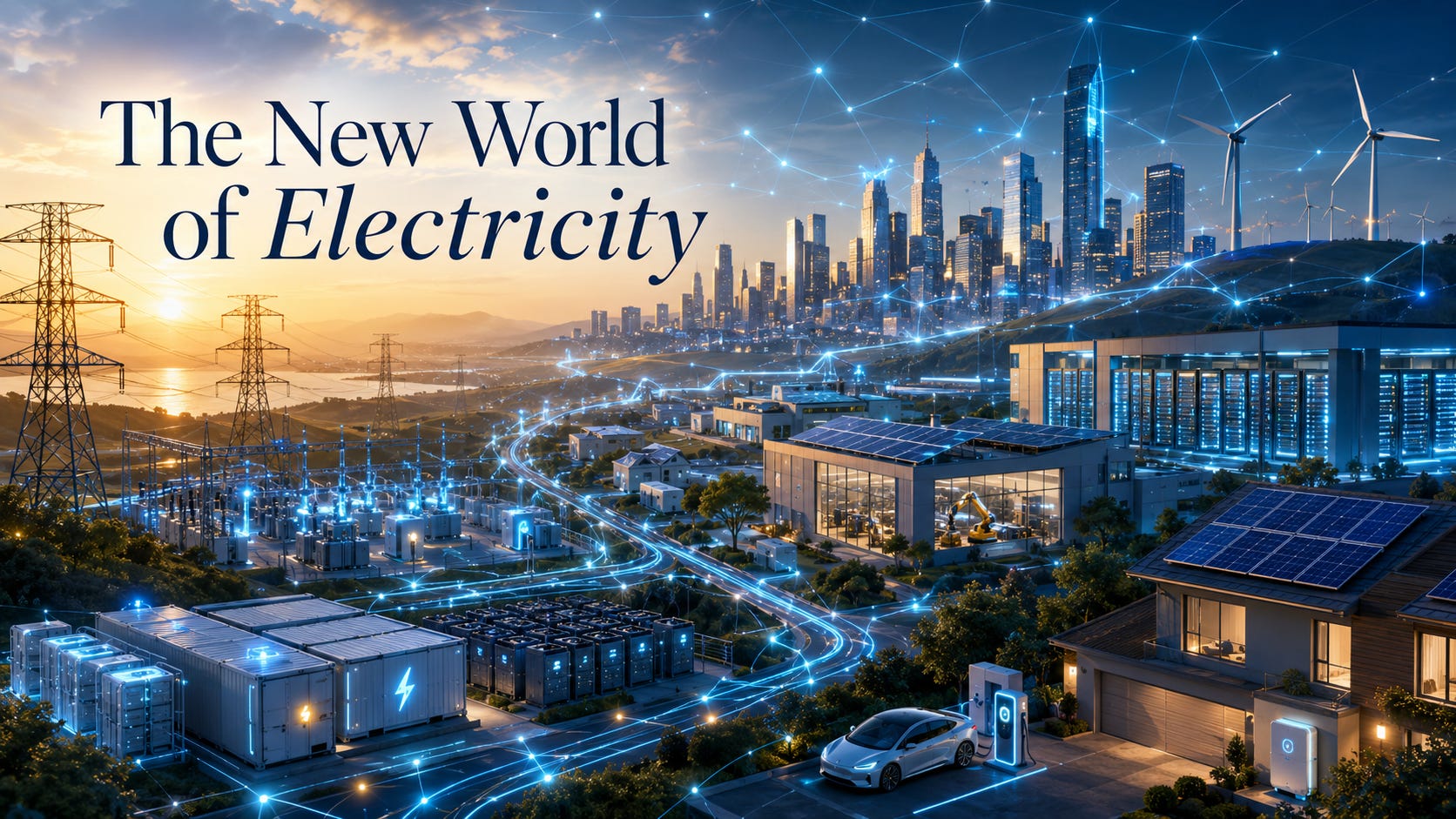
For most of modern history electricity has been treated as a background service, vital but invisible, and noticed only when the lights went out or when the bill arrived. That world is now changing. We already cannot function without electricity because of the digital world we live in, but going forward electricity will become even more important. It will become the critical backbone of the twenty first century economy as we scale artificial intelligence and electrify transport, heating and much of industry. The ambition should be simple, which is to provide that electricity quickly, cleanly, affordably and resiliently. The challenge is that building out electrical infrastructure requires significant capital, which can push up power prices, create resistance from existing customers and discourage other energy users from switching to electricity. There is a solution, however, which is to make the system more intelligent.
The current electricity system was designed for a very different world. It was built to meet peak demand, which means vast amounts of grid infrastructure sit underused for much of the year. It is like building a motorway for the busiest bank holiday weekend of the year and then using it at half capacity for the rest of the time. If we continue with this approach, which is still the approach across much of Europe and the United States, we will overbuild everything. That will be slow, costly and damaging for economies and regions that do this. The alternative is to build more intelligence into the power system.
This is where batteries change the physics and economics of the grid. Batteries are best understood as the shock absorbers of the electricity system. Together with power electronics, they can support the grid technically by helping with frequency response, voltage control and system stability, but their deeper value is that they allow electricity to move through time. They charge when supply is plentiful and cheap, and discharge when demand rises or the grid is stressed. That sounds technical, but the implication is revolutionary. Batteries allow a grid to use its existing infrastructure more efficiently. They can absorb more solar and wind, reduce peaks, ease congestion, improve reliability and help accommodate the growth of data centres, electric vehicles and heat pumps. The answer is therefore not just to build more power stations and more wires, although we will need both, but to use the infrastructure we already have far more intelligently.
That is why distributed batteries matter so much. Big batteries connected to the transmission system are valuable, but batteries placed close to demand and close to bottlenecks can be even more valuable. A battery beside a supermarket, factory, school, warehouse, data centre or local substation can relieve stress exactly where that stress appears while provding backup power and resiliencs. Those batteries can reduce peaks, absorb surplus electricity, support local networks and make the whole system work better. Over time, batteries will not only sit in containers beside buildings but they will be in our homes, factories, offices, vehicles and even household appliances. Batteries will become ubiquitous, quietly embedded across the economy and used not just as private assets but as shared system resources that benefit everyone.
This fits with the bigger shift I have been writing and talking about for years, which is the move from molecules to electrons and intelligence. The old energy system was organised around molecules. Coal, oil and gas were extracted, transported, traded and burned, with the system shaped by geology, shipping lanes, pipelines, chokepoints and geopolitics. The new system, in contrast, is organised around locally produced electrons. Solar panels, wind turbines, batteries, electric vehicles, heat pumps, power electronics and digital controls all produce, move, store or use electricity, but the final key layer is intelligence. Artificial intelligence, software, sensors and automation will increasingly coordinate the system in real time. Basically, electricity enables AI while at the same time AI also optimises electricity. That feedback loop is the heart of the twenty first century economy.
This is not simply an energy transition. It is a productivity transition. Once energy becomes digital, controllable and flexible, every machine becomes part of the system. A car is no longer just a car but a battery on wheels. A building is no longer just a passive consumer but a flexible energy asset. A data centre is no longer just a power hungry box but a strategic industrial facility that can be located, managed and optimised around the needs of the wider electricity system. What this means is that the winners will be those who generate, store, shift and manage power, either by themselves or with the help of energy service businesses.
The strategic implication is enormous. In the fossil fuel world, competitive advantage came from controlling reserves, pipelines, refineries, ports and shipping lanes. In the electricity world, advantage comes from cheap generation, strong grids, storage, flexibility, digitalisation and low cost capital. Countries that can generate cheap electricity, move it to where it is needed, store it when it is abundant, price it intelligently and finance it cheaply will attract the industries of the future. Artificial intelligence, robotics, autonomous vehicles, advanced manufacturing, defence technologies and data centres all require cheap, reliable and rapidly scalable electricity.
This is why the debate about data centres is often framed the wrong way. Yes, data centres use a lot of electricity, but if managed intelligently, they can improve system economics rather than destroy them. Large new demand points create demand for electrons. If those electrons flow through existing infrastructure at times when the grid is underused, they spread fixed costs over more units of consumption, which can help lower average system costs. The condition is that the demand must be flexible, batteries must be deployed in the right places and regulation must reward utilisation rather than endless asset expansion. Otherwise we simply add new demand, new peaks, new wires and new costs but done properly, batteries and flexible load can turn growth from a problem into a solution.
The real opportunity is to move from an energy system built around scarcity to one built around surplus. Solar and wind are variable, but variability is not the same as uselessness. Variability becomes valuable once the system has storage, flexible demand and intelligence. There will be hours when electricity is extremely cheap. Those are the hours when we should charge vehicles, heat water and fill batteries. In the old world supply was moved up and down to meet changing customer demand. In the new world of energy abundance, demand as well as batteries will respond to changes in power supply. That is a very different world and requires very different thinking.
The really exciting part is that this future is not a fantasy. The technologies already exist. Solar is cheap, batteries are scaling, power electronics are improving and AI is advancing faster than almost anyone expected. The hard part is not the technology but the institutions. Success in this new world will require the biggest redesign of the energy system since the rise of coal and oil. It will reshape geopolitics, industrial strategy, capital allocation and the structure of everyday life. It will decide who wins AI, who keeps industry, who controls strategic infrastructure and who remains dependent on volatile global fuel markets. The great energy story of the next decade is not simply that we will produce more clean electricity. It is that electricity will become the operating system of the economy. And once electrons are joined by intelligence, the world changes completely.
I agree, Gerards on target. Humor mixed in the comment.
I speak regarding USA as I have no legit right to speak about EU among other areas. The demand for Electricity is huge in the US, Air conditioners get triggered at 70 deg F and don't shut off for the next 5 or so months. The EU as I know it, rarely run AC at levels the US does and especially not for almost 50% of the year. Hmmm, Gluttony vs wisdom, one of life's imponderables?
There is a parody to the data center economics, where bigger starts to get "bad-der", more expensive, which is the current model. Distributed Data centers allow for any rural area to be utilized without the current 2 year to never-gonna-happen interconnection timeline. Data centers can not be supported by any grid especially requiring GWs 24/7/365, 4X backup? Your seeing the birth of SMR fast tracking if they can get a grip on the crazy unseen costs.
Consumers haven't realized, and are not being told the cost per kWh is so outdated by structure, it needs to be raised to meet growth. First, a de-complication of the system, which will never happen but at least I suggested it.
Gerard is beyond plausible but as long as the Utils figure out how to get their cut from the "savings/efficiency". Literally adding an additional "fee" for saving money, layered into the stack using terms that do not resemble English.
Electricity is too in-expensive as an energy source, the "grid-upgrade" cost is staggering that's why its mostly at a standstill.
One answer: Distributed data centers not monoliths, distributed energy generation, distributed Storage and ice it all down with AI. That's goes for both utility & consumer.
...and maybe one day someone can tell us why the US buys cross-border Hydro from Canada, then in turn sells back Fossil-gen'd electric at an escalated price? Talk about an imponderable.
Great Read Gerard. Always on target.
Great article, and we need more like it.
I imagine it like this. What if oil behaved like electricity and battery technology?
Every house could become its own small oil refinery, manufacturing and storing oil on site. Not only could people produce their own oil, they could potentially sell the excess back into the system.
Imagine if the price of oil dropped dramatically at night. You could buy it cheaply while everyone else was asleep, store it in your home tank, then use it the next day when prices were high. A factory could do the same. A school could do the same. A village could do the same.
Then imagine your car did not just consume oil, but could store it and give it back when needed. Your car would become part of the energy system, not just a machine that burns fuel.
Imagine if you could get your oil from an almost unlimited array of countries and methods, instead of being reliant on a few big vendors controlling the cost. Also, since your oil could come from almost anywhere in the world, and you could also make it yourself, you would be more resilient to global issues that might limit or shut down supply in one area.
So my biggest question is this why are governments not moving faster!