
Nuclear's Timing Issue

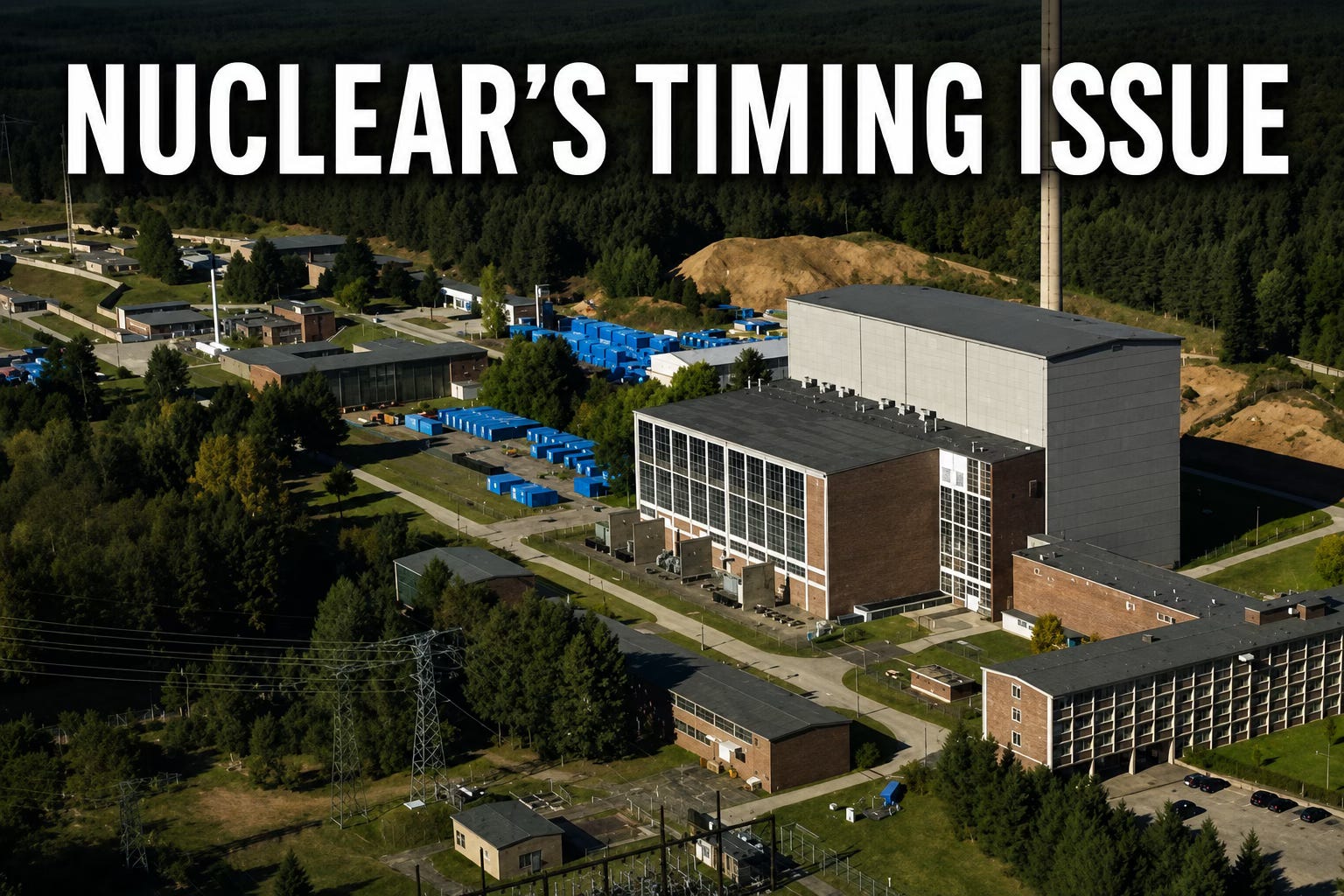
I recently visited Rheinsberg, a small town north of Berlin that is home to a 70 MW nuclear power plant which first came online in 1966. The plant stopped operating in 1990 and decommissioning began shortly afterwards. More than thirty years later, that work is still unfinished with full decommissioning now expected to be around 2040, with costs estimated at over €1bn. Standing there, the nuclear renaissance that many people, particularly in the United States, are now talking about suddenly felt very far away and the plant reminded me of the huge timing issue with nuclear.
On paper, nuclear looks like the perfect solution for a world searching for abundant clean energy. Its greatest advantage is energy density, meaning that a very small amount of fuel can produce an enormous amount of energy. To put it into perspective, 1 kilogram of uranium can produce roughly as much energy as thousands of tonnes of coal. The heat from the nuclear reaction is then used to drive turbines and generate electricity around the clock with very low operational costs.
The problem is that in the Western world we have largely lost the ability to build nuclear power plants quickly or cheaply. Take Hinkley Point C in the United Kingdom, which was originally expected to be producing electricity by now. The final investment decision was taken in 2016, but when the plant eventually comes online sometime beyond 2030 it will likely have cost well over £40bn, making it one of the most expensive power plants ever built, and at least five years behind plan.
Part of the challenge is that almost every large nuclear project is still effectively bespoke. That is why so much hope is now being placed on small modular reactors, or SMRs. The idea is simple enough, standardise smaller reactors and manufacture them in factories rather than build giant one off projects on site. In theory this should reduce both cost and construction time. The issue however is that there are multiple competing technologies, no clear winning design, and as a result it remains uncertain whether SMRs can be commercialised at scale before the mid 2030s.
The deeper issue though is speed. Even in the most capable jurisdictions, nuclear projects consume extraordinary amounts of time, capital, political attention and institutional capacity. Planning, permitting, financing and construction can easily stretch over a decade and in today’s world that matters enormously because the global economy is now evolving on much faster timescales. Artificial intelligence companies need power now. Data centres are being built now. Countries across the Global South need electricity now. At the same time industrialised economies are electrifying transport, heating and industry while simultaneously powering AI, automation and an increasingly digital economy. These systems evolve in months and years not decades. This raises an important question. If nuclear is so slow to bring to market with costs unclear, why are we suddenly talking about a nuclear renaissance?
Part of the answer is that nuclear fits naturally into the strategic and military worldview of the United States. Nuclear alligns with its desire to preserve leadership in a technology that has been for 80 years at the crosspoint between energy, national security and industrial prowess. SMRs and especially nuclear fusion carry the allure of near limitless and cheap clean energy and the possibility of a breakthrough that could fundamentally reshape civilisation itself, not least because fusion is the same process that powers our sun.
There are whole host of other countries such as the UK and France who are looking to expand their nuclear fleets and then there are countries like Poland and Egypt who are looking to build their first plants, but let’s be clear they are all being built for a mixture broader strategic reasons linked to industrial capability, geopolitical positioning, energy security and defense purposes. It is not just about producing electricity.
None of this means nuclear generation has no role to play. Existing fleets in countries such as France and Japancontinue to provide enormous value, particularly where the capital costs are already sunk and institutional knowhow remains strong. But one of the lessons I took away from Rheinsberg is that nuclear is not simply an energy technology. It is a multi generational commitment. Countries entering nuclear for the first time are not just committing to building reactors, they are committing to managing those systems, their waste and eventually their decommissioning for decades after the electricity has stopped flowing. And the big question is whether this makes any sense or not.
Toni - Yes end of life is usually built in, however 1966 im doubting the analysts got it remotely close, inflation that is. Change of safety procedures with soaring costs all add to the "miss" which I am betting is huge. If they did escalate (accurately) to compensate the expense, Im very surprised but my next big question is, the past 8~years has seen extraordinary inflation rates. Electric rates have risen but they would have accelerated far beyond what they are now. Note: I only opine because I did research on ~1976 Brookhaven Nuke, Long Island NY that was never turned on. The debt has grown from $2B to $10B which sooner or later the rate payers will absorb. This Island community pays $600Million a year in serving that debt and still not enough. Push it down the road but sooner or later, one generation of rate/taxpayer will be picking up the tab.
But as for this GREAT article, Electricity prices are quite underpriced since energy is all supposed to be fungible for the most part, except electricity it seems The cost of a kWh in the USA should be around $0.75-$1.10 arguably, which is in-line with $2.75-$4.50 per gallon of gas.
Residential electric or C&I and now EV's, then we have Direct Current as well as Alternating Current which are separate products whether you look at it that way or not. Remember the Edison vs Tesla story, these are separate products by patent.
Electrical distribution is antiquated by any standard and nukes are a step backward, only my opinion. (Many valid arguments either way).
Storage and proper rise in distributed energy is the mass answer, and the non-eligible, just charge storage from utility off peak. That's a huge step towards Under-capacity.
SMR's Its still an issue, several projects stopped due to rising costs but it has some legs.
Gerard,
Belated Happy B’Day.
Interesting piece on Nuclear. It would make a great contribution to the emerging debate on this topic in Ireland, hosted in the pages of the Irish Times. How interesting that Nuclear is seized upon as the great solution - in this time of Fossil Fuel supply shock and for good measure in its most aspirational and commercially elusive form - Small Modular Reactors !
Good luck with any promoter getting through planning in Ireland with this distributed type of Nuclear Generation. I suspect the next suggestion will be that SMRs should be located at sea, out of sight. Speaking of which, a letter today enthuses about the use of Submarine Nuclear generators, based on their obvious reliability over the last 70 years. I doubt if the operational track record of these vessels would ever be revealed on National Security grounds, so quite how a letter writer to the Irish Times can assert such reliability is beyond me. But typical of many claims made by fans of Nuclear generation.
But the real wonder is that in face of a “here and now” problem, people reach for nuclear solutions that are not practically available rather than an accelerated and ambitious roll-out of offshore wind.