

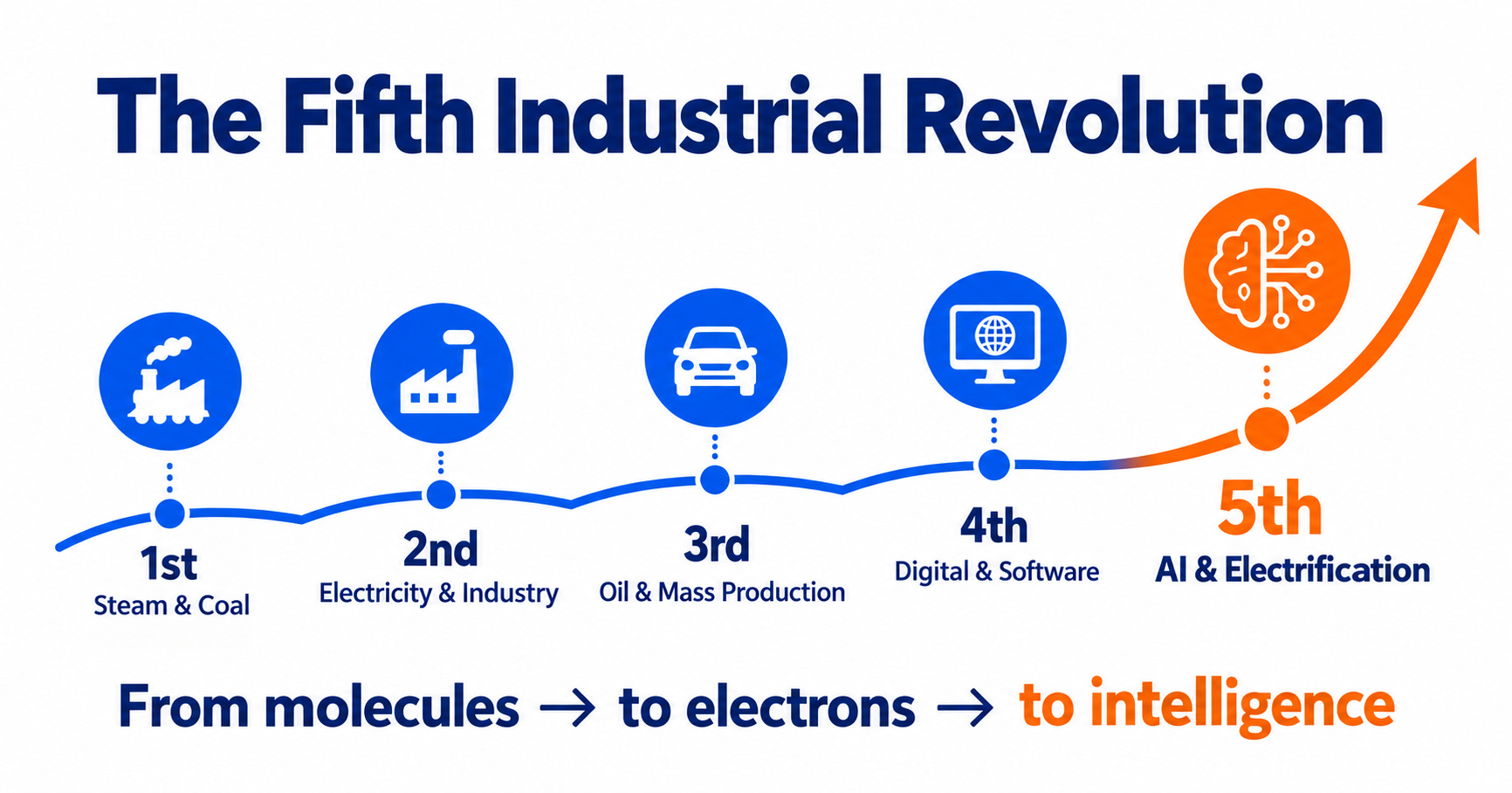
I believe we are at the start of the Fifth Industrial Revolution, which will be the largest technological and economic transformation in our lifetime. It will be driven not by one technology but by the convergence of artificial intelligence, robotics, automation, advanced computing and increasingly intelligent infrastructure, and the lifeblood of all of it will be electricity. This revolution will create some of the greatest investment opportunities we have ever seen, but capturing them will not be easy as industrial revolutions do not unfold in straight lines and they do not distribute their rewards evenly. New companies emerge, old business models disappear and capital moves at enormous speed from yesterday’s winners to what people think will be tomorrow’s. In revolutions, people die but more often companies fail, industries collapse, jobs disappear and fortunes are destroyed. The challenge for investors in the next years is knowing where and when to invest and disinvest.
To understand what comes next, we first need to understand what created the world we are in today. For more than two centuries, the industrial world has been built around fossil-fuel molecules starting with coal which powered the steam engine, then oil which transformed transportation and natural gas which heated our homes, generated electricity and became a critical raw material for industry. What these fossil fuels did was liberate humanity from enormous amounts of physical labour which in turn enabled us to scale up agriculture, manufacturing, transport and build modern cities. A single barrel of oil which you can buy for under $100 contains approximately 1,700 kilowatt-hours of energy which is over 4 years of sustained human physical labour. And the result of those fossil fuels has been massive economic progress and prosperity the likes of which mankind has never seen. That said we are at the start of another industrial revolution that will radically change not only the world of energy but the global economy and it will do so faster than any revolution we have seen in the past.
The bedrock of this revolution is artificial intelligence which is often described as another digital tool but this is wrong as AI represents the automation of cognition itself. It makes intelligence scalable in much the same way that the steam engine made physical power scalable. AI will help companies design products, operate factories, manage supply chains, acquire customers, set prices, predict equipment failures and allocate capital and it willl enable machines to increasingly sense, decide, act and learn.
Another mistake is to see AI as something virtual as it is actually profoundly physical. The semiconductor NVIDIA’s CEO Jensen Huang describes the process very simply as ‘electrons go in and tokens come out’ which means that data centres are becoming AI factories that use electricity to produce an entirely new commodity called intelligence. Elon Musk has reached much the same conclusion from a different point of view as he recently warned that the constraint on AI development is moving from the availability of advanced semiconductor chips to the availability of electricity and that economic power in the intelligence age may ultimately be determined by how much electricity a country or company can produce and intelligently deploy.
I believe the convergence of electricity and artificial intelligence also means that we are at the beginning of the end of the fossil-fuel era and in fact I think we are already seeing that today when you look at what is going on in the global oil market. If you had have asked me a year ago ‘What would happen to global oil prices if the Strat of Hormuz was closed for 6 months” I would have say that oil prices would be above $200 a barrel and the world would be in recession. But this is not the case and the likely reason is that Chinese demand for oil has already peaked and that much of their demand for oil in recent years has actually been for storage purposes. And that’s not to say that we don’t need fossil fuels. We do and they will remain essential for years, but electricity will become increasingly dominant because our digital devices and AI need electricity. That electricity will also be increasingly clean because the cheapest and quickest ways to add new electricity generation produce is with mass manufactured technologies such as solar and batteries that become cheaper and better with every deployment, while at the same time the use of AI makes the entire electricity system more efficient, intelligent and controllable. Bottom like is that we will gradually leave fossil fuels behind because clean electricity becomes cheaper, more abundant and more useful. For investors, however, recognising the direction is the easy part while identifying where lasting value will be created and avoiding the many technologies, companies and assets that will fail along the way will be much harder.
The winners will not necessarily be today’s largest energy companies, automobile manufacturers, utilities or industrial groups. Size can become a disadvantage when it is tied to the wrong assets, technologies and assumptions and companies that dominate one industrial era rarely surrender gracefully to the next. A good example of this is Volkswagen which will have a painful set of years ahead of it, as it sheds 100,000 jobs by 2030. It became the world’s largest automobile manufacturer by mastering the engineering, manufacturing and supply chains of the internal combustion engine, but the competitive foundations of the industry have shifted towards batteries, semiconductors, software and artificial intelligence, areas in which the leadership does not sit in VW. Volkswagen may yet successfully reinvent itself, but its experience is a brutal reminder that the assets, scale and expertise that created dominance in one technological era can become enormous liabilities in the next one.
The future winners will be companies that combine energy, data, AI and physical infrastructure to create entirely new products, services and business models. Some of the greatest opportunities will emerge in what I call the last mile of electrification which is the physical equipment and services needed to connect new generation, storage, electric vehicles, heat pumps, factories and data centres to the electricity system. Transformers, switchgear, inverters, cables, substations, cooling systems and grid connections and their installation ands servicing may appear less exciting than AI models or batteries, but they are rapidly becoming the critical bottlenecks without which the entire transformation simply cannot happen.
There will also be enormous opportunities for companies that add intelligence to this physical infrastructure. A transformer connected to sensors, data and AI is no longer merely a piece of electrical equipment but an intelligent asset whose condition can be monitored, whose failure can be predicted and whose capacity can be managed more effectively. The same will be true of buildings, batteries, industrial equipment and millions of devices at the edge of the electricity network. The biggest winners may therefore be neither pure technology companies nor traditional industrial manufacturers, but businesses capable of combining software and intelligence with the ability to deliver, finance, operate and maintain physical assets in the real world.
But there will also be casualties. Companies attached to obsolete technologies will decline, while businesses that treat AI as an add-on rather than a fundamental change to how they operate will be overtaken. This is what makes investing through an industrial revolution so difficult. It is not enough to identify a technology with an enormous future. Investors must understand where the bottlenecks will emerge, where value will be captured, which parts of the supply chain will become commoditised, which business models can scale and which companies possess the capital, operational expertise and commercial capabilities required to survive. The most glamorous technology will not necessarily produce the greatest returns. Very often, the real money will be made by the companies that solve the unglamorous but unavoidable problems standing between technological possibility and deployment at scale.
In conclusion, we are not simply entering another investment cycle but a fundamental reordering of the global economy and I believe that the greatest returns will come from understanding how intelligence, electricity and physical infrastructure are converging, identifying the bottlenecks that that convergence creates and backing the companies capable of solving them at scale. There will be false starts, spectacular failures and enormous destruction of capital in the coming years but there will also be opportunities to build some of the most valuable companies of the next century.
GREAT WRITTING..
From molecules → to electrons → to intelligence
It is thanks or because of our collective intelligence that we were able to master the alchemy of fire and then minerals to finally master the electric fairy, make it a kind giant robot, but why, for whom, what purpose? Make a mountain of non-recyclable chips that will have had more joule effect in five years than an African will consume in his life?
Digitization only brings enshittification.