

By Gerard Reid and Carsten Pfeiffer
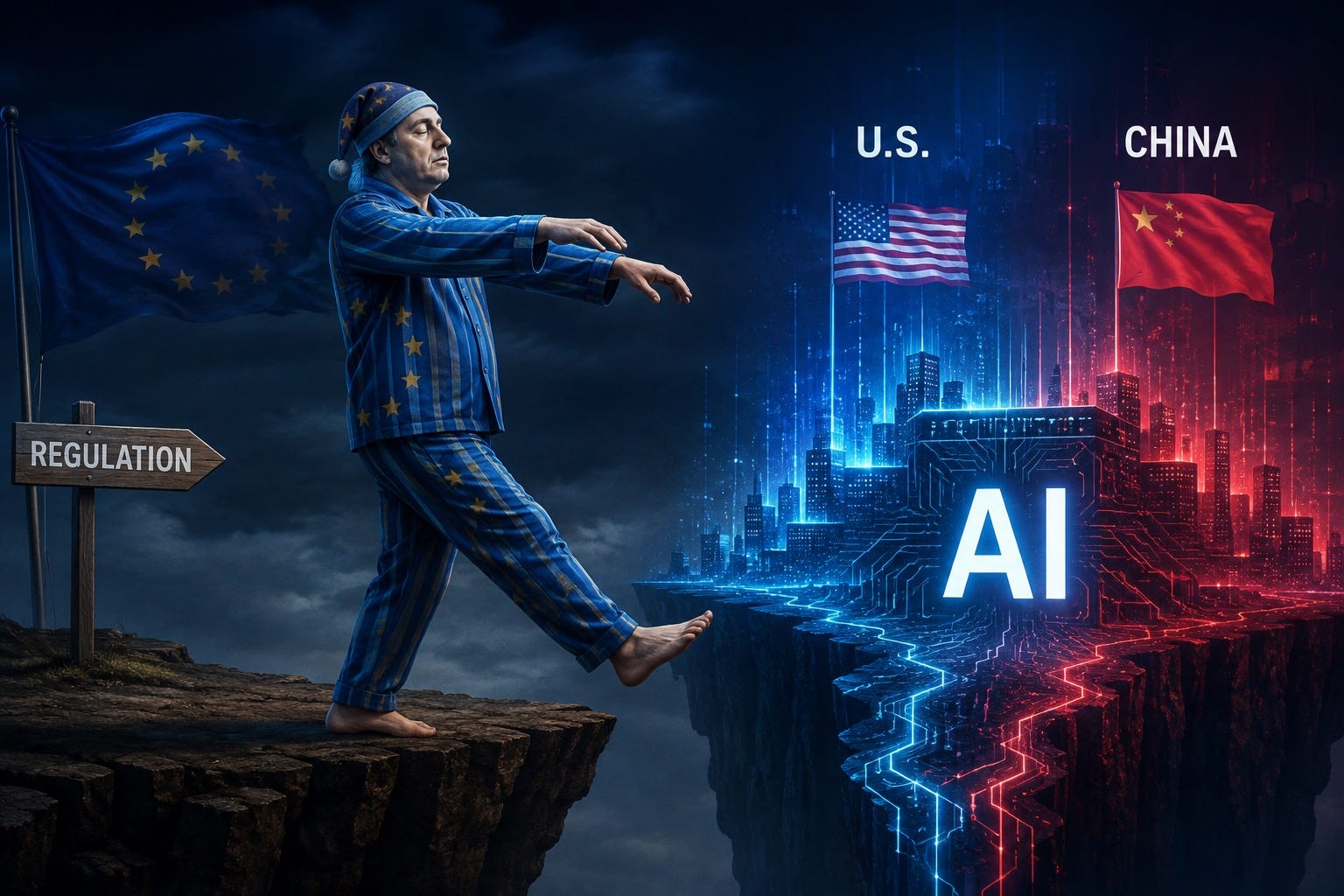
While European political leaders continue to debate how to regulate artificial intelligence, the United States and China are increasingly treating it as a strategic national asset. Case in point Anthropic’s Claude Mythos, the usage of which US government has recently restricted. It is also only a matter of time before a Chinese AI laboratory develops a frontier model with similar capabilities and when that happens, Beijing will face the same dilemma that Washington is facing today. Should such a powerful technology be freely available to everyone or should access be restricted because of its potential implications for cybersecurity, national security and economic competitiveness? Our suspicion is that China will make much the same decision as the United States and restrict access as the bottom line is that frontier artificial intelligence is rapidly becoming a strategic national asset rather than simply another commercial technology. Meanwhile back in Europe we are still asleep to the biggest technological shift in the history of mankind.
Many of Europe’s political and business leaders still do not fully appreciate the significance of the AI revolution or the speed of innovation and continue to see artificial intelligence as another digital technology that can be regulated and gradually incorporated into the economy, when in reality it represents one of the biggest economic, industrial and geopolitical shifts in history. AI will transform every sector of the economy, from manufacturing and healthcare to finance, defence and scientific research, while also redefining national competitiveness. The bottom line is that countries that lead in artificial intelligence will increasingly shape the technologies, standards and industries of the future.
History repeatedly shows what happens when nations fail to embrace technological revolutions. China dominated the global economy for centuries but largely missed the Industrial Revolution, allowing Britain and later the United States to overtake it economically and militarily. The Soviet Union spent decades trying to replicate Western semiconductor technology, but in an industry advancing exponentially, copying meant permanently chasing yesterday’s innovation rather than creating tomorrow’s. China learned from both experiences and is now investing enormous resources to ensure it does not miss the AI revolution. The United States is similarly investing massively in all things AI. Europe, in contrast is not. Winning in artificial intelligence requires enormous amounts of capital, world-class engineering talent, hyper scale computing infrastructure, abundant electricity, a willingness to take extraordinary commercial risks and the determination to build globally dominant businesses. On every one of these dimensions Europe is still at a disadvantage.
Europe’s instinctive response is often regulation which certainly has a key role to play in protecting citizens and creating trusted markets but regulation is not a growth or an industrial strategy. It cannot build frontier AI models or quantum computers, finance hyper-scale data centres, create global software champions or develop the entrepreneurial culture required to compete with companies investing tens of billions of dollars every year. A system that responds to every strategic challenge with another layer of regulation gradually loses the ability to build, scale and lead. This is perhaps Europe’s greatest weakness. It has become exceptionally good at identifying risks but far less successful at creating globally competitive technology businesses. It has built institutions that excel at supervision and creating regulations, yet struggle to mobilise the capital, talent and ambition needed to compete at the technological frontier.
Some argue that Europe can simply regulate foreign AI providers or restrict Chinese technology in the same way that it is debating restrictions on Chinese solar inverters. Yet that would merely increase dependence on American technology as Europe should not assume that future American administrations, regardless of political party, will automatically place European interests alongside their own. Just as access to advanced semiconductors, defence technologies and critical minerals have become increasingly influenced by geopolitics, frontier AI is likely to follow the same path. Governments naturally prioritise their own economic competitiveness and national security, and the United States and China are unlikely to be any different.
Europe therefore faces a stark choice. It can either make the bold decisions needed to compete in artificial intelligence and technology frontiers or accept a gradual decline into becoming a third-tier economy in what will almost certainly be the greatest technological revolution in human history. The biggest mistake Europe could make would be to believe that it can simply copy Silicon Valley. The reality is that Europe failed to produce the defining technology companies of the internet era. It has no Google, Amazon or Microsoft, and today it has no NVIDIA, OpenAI or Anthropic. Simply doing more of the same while hoping for a different outcome will not work.
That does not mean Europe cannot become a leader in the age of artificial intelligence. China is demonstrating that there is more than one path to technological leadership, and Europe starts from a position of considerable strength. In contrast to China, Europe has access to the best AI-Chips and it remains home to many of the world’s leading engineering companies, advanced manufacturers, industrial software firms, automation specialists, universities and research institutions and it also possesses one of the world’s largest and most sophisticated electricity systems, which is becoming an increasingly important strategic advantage as AI becomes ever more electricity intensive. Europe has also produced promising AI companies such as Mistral, proving that the talent exists.
What Europe needs to do is support the development of its own frontier AI ecosystem by backing companies such as Mistral with the capital, compute infrastructure and regulatory environment they need to compete globally while at the same time rapidly deploying AI across manufacturing, healthcare, logistics, energy and public services.
Finally, the AI race is no longer simply about technology. It is about economic competitiveness, industrial leadership and ultimately geopolitical influence. Europe still has the assets to succeed, but only if it recognises that this is not another digital policy debate. It is the defining industrial challenge in the first half of the 21st century.
Europe could learn from China: Deepmind did not have the best hardware, or the enormous funds of the American hyperscalers. They found a way around that issue, the resource restriction forcing them to trying a different approach. Europe (EU plus UK and maybe a few others) should bundle their forces and particularly look into alternative ways for frontier models that might use less energy and do not rely on trillions of parameters...
There is no moat to these LLMs. In the unlikely event that anyone other than Nvidia, AMD, Broadcom and the other hardware vendors figure out how to actually realize any profit from the use of these tools, it's easy to grab the best open model and build on that to match.