

“A country that can’t feed itself, fuel itself or defend itself has few options.” Those words from Canadian Prime Minister Mark Carney stayed with me all week. When I look at Europe, I struggle to identify a single country that can genuinely do all three. France comes closest. It can feed itself, it can defend itself, and it has strong domestic electricity generation. But even France remains dependent on imported oil and gas. At the European level, the picture is even clearer. Europe can largely feed itself, but it cannot fully fuel itself, and it cannot defend itself without external support. I spent time in Davos last week and I must admit I did not enjoy it. What I felt was the unravelling of something that matters deeply to me: the relationship between Europe and the United States. There was a quiet sense of loss and a recognition that the Anglo American world I grew up in, built on shared language and history, common assumptions about culture, values, the rule of law, institutions and leadership, is breaking down. With that comes a collapse in trust.
At Davos, Mark Carney delivered what I believe will be remembered as one of the most important speeches of our time. He was calm, precise and unsentimental. His argument was simple but profound. We are not in a transition, we are in a rupture. Economic integration has become a weapon. Tariffs, finance and supply chains are now tools of coercion. His conclusion was equally clear. Countries must protect themselves. That is Canada’s path. The question is whether Europe will follow.
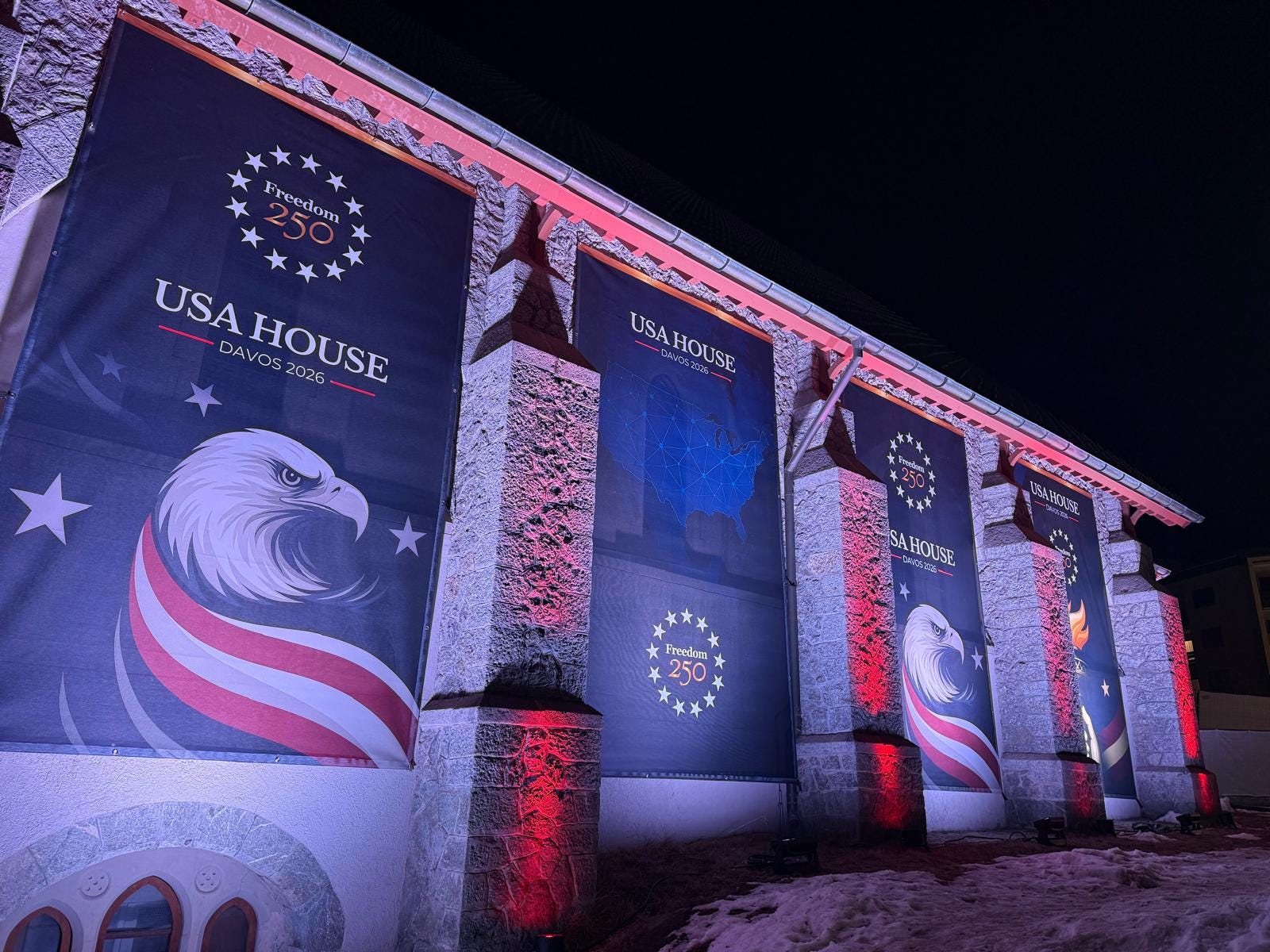
Walking down the Promenade in Davos, the message was unmistakable. America First was everywhere. Building after building had been taken over by US technology companies spanning AI, cloud, data and defence. Even the church, traditionally neutral ground, was draped in US colours. Team America did not come quietly. It came in force, and it came to send a message.
In contrast, Donald Trump’s speech landed badly. I stopped listening part way through, not out of anger, but out of boredom. I was tired of fact checking statements that were simply untrue. What struck me most was how many people around me had also switched off. When leaders stop listening, trust has already eroded. Later that day, a senior German politician texted me asking whether Trump had really said he would take over Iceland and Ireland next. He had not mentioned Ireland, thankfully, but that was not the point. When allies start asking questions like that, something fundamental has shifted. So what should Europe do?
Firstly, Europe needs to come closer together. Western Europe has achieved something extraordinary over the past eighty years. A continent that tore itself apart twice in the twentieth century chose cooperation over conflict, democracy over tyranny, and institutions over force. Yes, the EU is far too bureaucratic, but the outcome has been unprecedented peace, prosperity and trust. That achievement must not be weakened. It must be built upon.
We are now in emergency territory. We need more Realpolitik, as the Germans would say. That means pragmatism over process and action over paperwork. It means closer cooperation among a coalition of willing countries on energy, security and infrastructure. This could involve the re entry of the United Kingdom into the EU, and potentially the widening of the bloc to include countries such as Iceland, Switzerland and parts of the Balkans, assuming they wish to join. It also means accepting that some EU member states may block or veto progress. Given the seriousness of the moment, Europe may need to move ahead without them.
Secondly, Europe needs to electrify its energy system at speed and diversify its fuel imports. Electrification is the most powerful tool Europe has to reduce structural dependence. Transport, heating and industry need to shift away from imported fuels towards domestically produced electricity. At the same time, Europe must ensure that its power system is resilient and fit for the twenty first century. That means upgrading and digitalising the grid, particularly the distribution grid, to ensure resilience and reliability. Electrification alone, however, is not enough, at least not yet.
Europe will continue to need fuels for heavy industry such as chemicals and plastics as well as for the Dunkelflaute, those cold winter periods when there is little wind or sun. The lesson from the war in Ukraine is clear. Over-reliance on a single supplier is dangerous. But replacing Russian gas with expensive LNG (Liquified Natural Gas) from the United States does not solve the problem either. Energy security comes from diversity and that means multiple suppliers, a wide variety of routes and adequate local storage.
Thirdly, Europe must be able to defend itself without relying on US support. This is not about abandoning NATO. It is about removing a structural vulnerability. Europe still depends heavily on the United States for intelligence, logistics and credible deterrence. The challenge is how to do this quickly and cost effectively. Doing so at a European level makes sense because it avoids duplication and fragmentation. Europe has done this before. Airbus is the obvious example. By combining the aeronautical expertise of the UK, France, Germany and Spain, Europe created a global aerospace champion. The same logic now needs to be applied to defence, energy and dare I said technology.
That was one point Mark Carney missed and that is Europe also needs to be able to provide itself with its own critical technology. Europe cannot claim strategic autonomy while remaining entirely dependent on US technology providers for cloud services, enterprise software, operating systems, data platforms and increasingly AI infrastructure. That dependence may be efficient and cost effective, but it now carries serious strategic risk. AI in particular matters because it is the most important technological revolution in human history. Europe needs to step up to the plate, to use an American phrase, if it wants to remain relevant, let alone competitive.
Finally, Davos 2026 felt like a line in the snow. The world has changed. The question now is whether Europe can build the capacity to feed itself, fuel itself, defend itself and digitise itself fast enough. The alternative is a steady erosion of strategic options. That is not a future worth accepting.
Well when one door closes other ones usually open... China, Africa, India, Canada, Latam... Who said we have to do this alone...
Many of us in the US are as appalled as our friends and allies in Europe at the abandonment and rejection of the rules-based, principled, and mutually-beneficial security and economic arrangements that have preserved and enhanced trans-Atlantic prosperity for eight decades. It is clear that only a minority of Americans continue to support the current regime whose ignorance is only exceeded by their arrogance, infected from the top by fundamental dishonesty, gratuitous cruelty, xenophobia, racism, economic illiteracy, and preference of force over respect for law. As these ill winds increasingly blow against US citizens with casual violation of their Constitutional and human rights, resistance will only strengthen and provide a sharp reversal of direction when ballots are next counted -- assuming the degradation of US democracy has not reached the point where that next time does not come. We can only hope to regain the trust of others in our national character and cooperative intent that has been blithely undermined and along with it the security and economic benefits we only had because we were willing to share them. It will be a slow process, and cannot start until things change here.