

If you read the American headlines, you would think the race to electrify the automobile is over, following recent billion-dollar write-offs by Ford, GM and Stellantis and a refocusing of Tesla toward robotics. The narrative has shifted toward the idea that US consumers have rejected EVs and that it is back to basics for global producers. But step back from Detroit for a moment and global automobile sales tell a very different story. Back in 2020, global EV sales were around 3 million. Last year, in 2025, they reached 20 million, representing roughly a quarter of all cars sold worldwide. If you look at national market shares, the divergence becomes even more striking. At one extreme you have countries like Norway, where effectively every car bought last year was electric. Then there is China, the largest automobile market in the world, with 13 million new EV deliveries in 2025, representing around 60 percent of all automobile sales. This begs the question who is best placed for the structural changes taking place in global transport and the related technology shifts? The answer is pretty straightforward and it is not the United States.
The reason electric vehicles are winning against internal combustion engines is very simple and it has little to do with ideology and much more to do with physics, economics and systems thinking. The internal combustion engine is an extraordinary piece of nineteenth-century engineering that reshaped our world, but it is fundamentally inefficient. Roughly seventy percent of the energy in petrol is lost as waste heat. A battery-powered electric drivetrain, in contrast, converts more than ninety percent of electrical energy into motion. That gap is structural and it translates directly into fuel cost advantages.
Then there is Wright’s Law, which states that every cumulative doubling of production reduces costs. We have seen this relentlessly in solar over the last fifteen years and we are now seeing it in batteries, the most expensive component in an EV. Battery pack prices have fallen by close to 90 percent over the past decade while performance has improved significantly, enabling longer range and lower production costs. What this means is that in China, EVs are now cheaper to build and buy than comparable ICE vehicles.
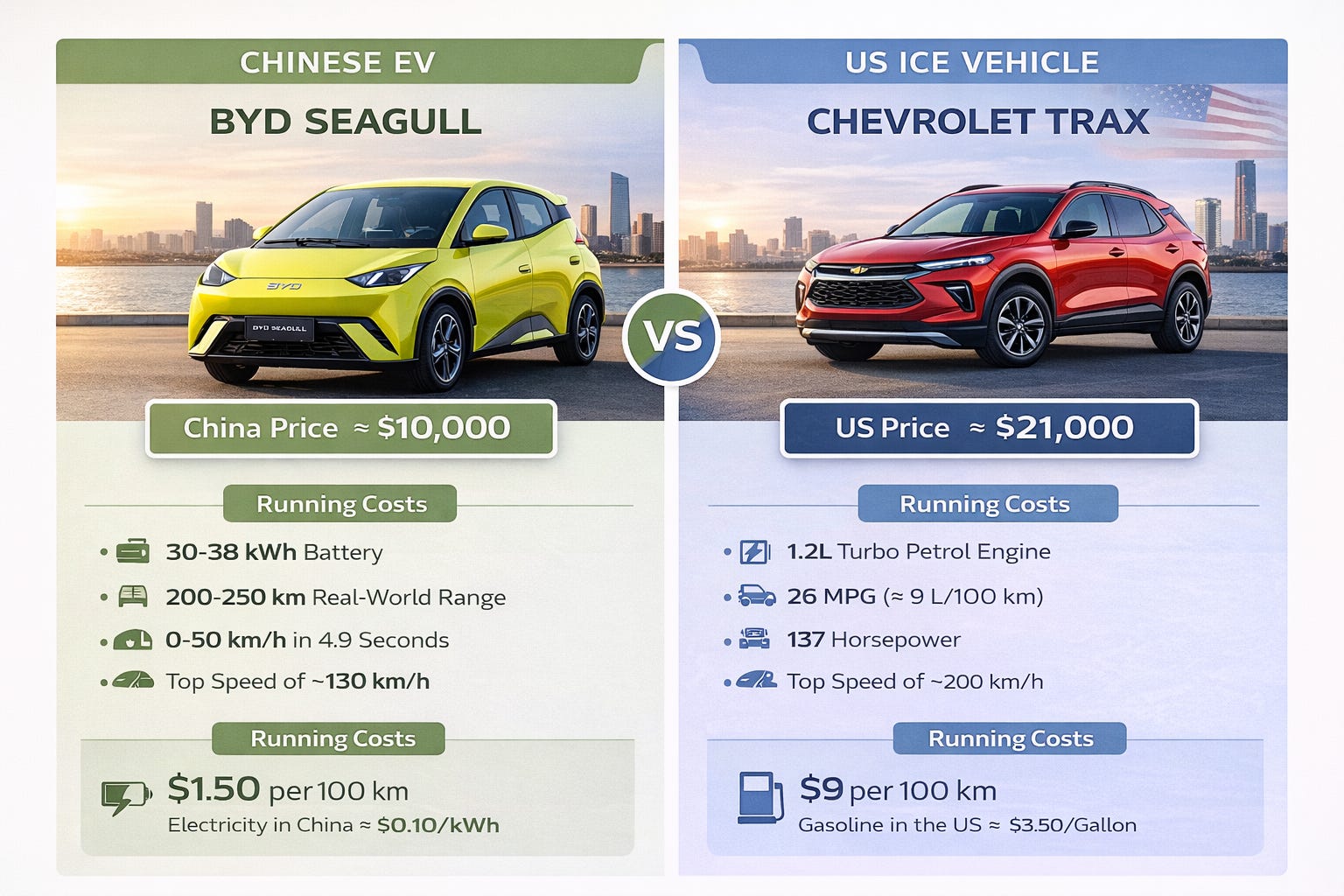
To illustrate this, let’s compare the cost of a BYD Seagull in China and a Chevrolet Trax in the United States. The Seagull sells in China for roughly $10,000 and consumes around 15 kilowatt hours per 100 kilometres in real-world driving. With Chinese electricity prices at roughly $0.10 per kilowatt hour, that translates into a running cost of approximately $1.50 per 100 kilometres. In contrast, a Chevrolet Trax in the United States starts at around $21,000 and delivers roughly 26 miles per gallon. At gasoline prices of around $3.50 per gallon, the fuel cost comes in at roughly $9 per 100 kilometres. In other words, the Chinese electric vehicle costs roughly one sixth as much to fuel and sells for roughly half the upfront price.
But cost is not the only reason why global transport is electrifying. There also are systemic reasons to electrify transport, from environmental improvements to energy independence and technological leadership. Removing millions of combustion vehicles and replacing them with electric scooters, buses and cars has improved air quality across China. It has also reduced oil demand in a country that imports the majority of its crude, strengthening the balance of payments and reducing geopolitical risk.
EVs also fit into the emerging energy system far better than combustion vehicles ever could. A fleet of 10 million EVs with 60 kWh batteries represents 600 GWh of distributed storage, enough to supply Germany’s power needs for roughly six hours. In a world of rapidly growing low-cost solar and wind, EVs become not just transport devices but grid assets.
The technology stack is equally important. Batteries, power electronics, advanced semiconductors, electric motors, heat pumps and software-defined architectures are not narrow automotive components. They are core technologies in a 21st century power system while also underpinning drones, robotics, autonomous systems, naval electrification, aviation electrification, advanced defence platforms. To build scale in EVs is to build capability in the core technologies of the twenty-first century.
China did not begin electrification with upper end market cars as was done in Europe and the US. It began with scooters two decades ago and the result is that today there are over 300 million electric scooters on Chinese roads and consumers have been plugging in or swapping batteries for years. That early mass adoption created scale in batteries, motors and power electronics long before electric cars reached majority penetration. Now that more than half of Chinese car buyers choose electric, the supply chain has reorganised around that reality. Universities are training the required engineers, while suppliers are investing and capital markets are backing the electric future. The result is that the ecosystem reinforces itself, products improve and prices fall, which in turn drives further consumer penetration.
As it stands, China is winning the global EV race. Last year it became the world’s largest exporter of automobiles, supported by intense domestic competition with more than 100 EV manufacturers vying for survival. That competition has pushed companies like the global leader BYD to become vertically integrated industrial systems combining batteries, semiconductors, software and highly automated manufacturing at unprecedented scale. BYD has grown from 0.5 million vehicles in 2020 to around 5 million last year and now employs close to one million people.
The uncomfortable truth is that American consumers did not sour on EVs. They encountered expensive vehicles, limited model choice and fragmented charging infrastructure. With Chinese EVs effectively blocked from the US market, the burden now rests on Tesla, Rivian and a handful of domestic players. Tesla understands the shift toward software-defined mobility and robotics and remains central to US electrification. Ford and GM, on the other hand, will continue generating cash from large trucks and SUVs for the coming years. But without structural reinvention, their global competitive position will continue to erode. Industrial history is unforgiving to incumbents that hesitate during technological inflection points. Think Kodak and the world will not stop electrifying transport because Detroit does not. Electrification is not a policy cycle but an industrial realignment which will have a massive impact on our world.
Well, I'll say it. Trump f'd us and the world.
Before we crucify anyone for the EV "sales stall" lets ask Detroit a question. Who leads your marketing division? Why on G-ds semi-green earth would any company target a cross section of the American consumer that screams old-school everything. The Ford F-series pickup, is the blood line of the working class/contractor/farmer, so why on earth would any company target a polar opposite demographic to that of the acknowledged cross section buyer?
The launch of all-things EV in the US was mishandled/mismanaged and the sales techniques were very misleading in every category. Tesla's were sold to a "tech-worshiping" cross section, and "young huggers".
Detroit sold to beer drinking, oil rig workers, 16 hour day manual laborers (farmers) with a few variations of course. How do they spell failure? 25% of the US are environmentally aware in the sense they shop anything organic and support Greta Thunberg. Then there is 25-50% perhaps who care but run on logic (whatever that means) Then you have 25% or more who simply adjust a little but will never hug a tree. Why did Detroit target this last group?
(Disclaimer) My percentages are generalized for thought, but the point is very accurate. Electric Pick-up trucks? Seriously? You don't launch with that.
As I have mentioned in other comments, Make it sexy again, anything can be made sexy, even oil-drilling.